
Your kidneys silently do one of the most critical jobs in your body — filtering approximately 200 litres of blood every single day, removing waste products, balancing fluids and electrolytes, regulating blood pressure, and producing hormones essential for overall health.
When kidneys fail — due to diabetes, hypertension, or chronic kidney disease — these functions collapse. Toxins build up in your blood, and without intervention, the situation becomes life-threatening.
Dialysis is the lifeline. It does artificially what your kidneys can no longer do naturally. There are two main kidney dialysis types — hemodialysis and peritoneal dialysis — and each works differently depending on the patient’s condition and lifestyle.
Let’s understand hemodialysis and peritoneal dialysis — and how each treatment works for kidney patients.
Hemodialysis Explained
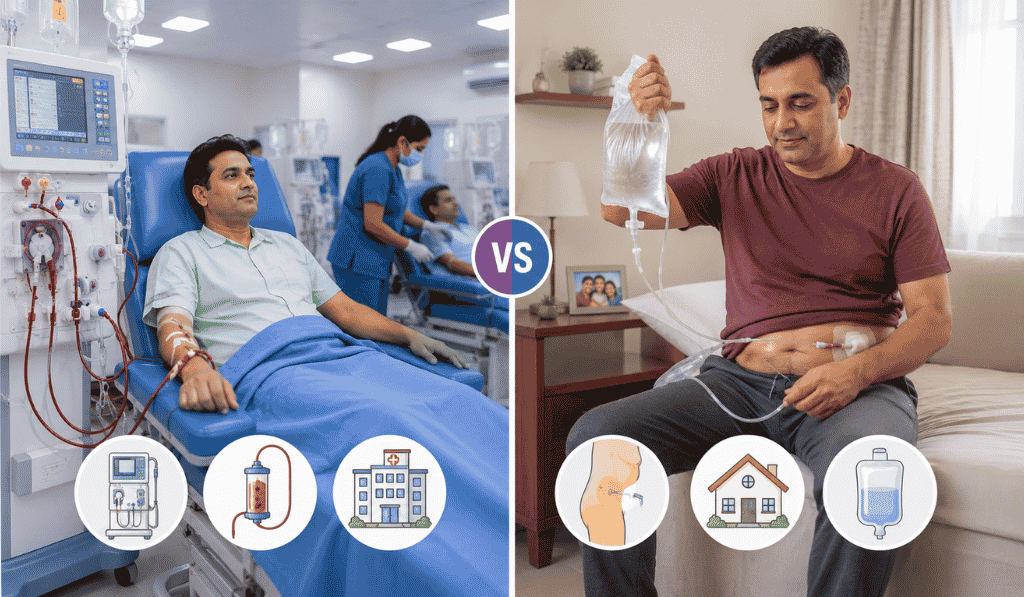
In hemodialysis, blood is drawn out of the body through an access point in the arm, cleaned by a dialysis machine, and returned to the body. Each session lasts three to five hours and is done three times a week at a dialysis centre. It is a well-established treatment, fully supervised by trained medical staff. At P.D. Hinduja Sindhi Hospital, Dr. Umesh provides expert hemodialysis care in a modern, fully equipped facility — making it one of the most trusted dialysis centres for patients seeking reliable kidney care.
Peritoneal Dialysis Explained
Peritoneal dialysis is one of the most flexible home dialysis options available today. It uses the body’s own abdominal lining as a natural filter. A soft tube is placed in the abdomen, and a cleansing fluid is filled in, absorbs waste from the blood, and is then drained out. This is repeated daily. It can be done manually through the day (CAPD) or automatically overnight using a small machine (APD). Because it is done at home, patients have far more freedom over their daily routine.
Hemodialysis vs Peritoneal Dialysis: What Sets Them Apart?
The core difference in hemodialysis vs peritoneal dialysis comes down to where and how treatment is done. Here is a clear side-by-side comparison:
| Hemodialysis | Peritoneal Dialysis | |
| Where | Dialysis centre | At home |
| How often | 3 times a week | Every day |
| How it works | Machine filters blood outside the body | The body’s own lining filters blood inside |
| Speed | Fast — during each session | Slow and continuous |
| Who manages it | Trained medical staff | The patient themselves |
| Flexibility | Fixed clinic schedule | Flexible daily routine |
Benefits and Limitations
Hemodialysis is ideal for patients who need close medical supervision. It is effective, reliable, and requires no home management. However, it ties patients to a fixed clinic schedule and comes with strict fluid and dietary restrictions. Peritoneal dialysis offers greater independence, fewer dietary restrictions, and is gentler on blood pressure. The limitation is that it requires daily commitment and strict hygiene — any lapse can cause a serious abdominal infection called peritonitis. Both treatments are effective when followed correctly.
Lifestyle Considerations
Your daily life plays a big role in deciding the right dialysis treatment that patients in Bangalore seek. Patients who work full-time, travel frequently, or cannot visit a dialysis center in Bangalore regularly will likely find peritoneal dialysis more practical. Those who prefer professional supervision, live close to a centre, or have health conditions that need monitoring are better suited to hemodialysis. The goal is always the same — a treatment that keeps you healthy. Dr. Umesh helps every patient find that balance.
Choosing Between Hemodialysis & Peritoneal Dialysis ?
Not every patient is suitable for both options. Hemodialysis is recommended for patients with heart conditions, prior abdominal surgeries, or complex health needs requiring frequent monitoring. Peritoneal dialysis suits patients with stable health, preserved kidney function, and the ability to manage home-based care independently. A thorough evaluation by a nephrologist is essential. Dr. Umesh at P.D. Hinduja Sindhi Hospital assesses each patient carefully to recommend the safest and most suitable dialysis treatment plan.
Expert Nephrology Guidance
Choosing between dialysis treatment options is not a decision to make alone. Dr. Umesh (MBBS, D.M., D.N.B. – Nephrology) at P.D. Hinduja Sindhi Hospital offers comprehensive pre-dialysis counselling, expert guidance on home dialysis options, and ongoing care after treatment begins. Whether you are newly diagnosed or reconsidering your current plan, the nephrology department is here to support you every step of the way.
Speak with the nephrology department at P.D. Hinduja Sindhi Hospital about your dialysis treatment plan today. The right treatment isn’t just the one that keeps you alive — it’s the one that lets you truly live.