
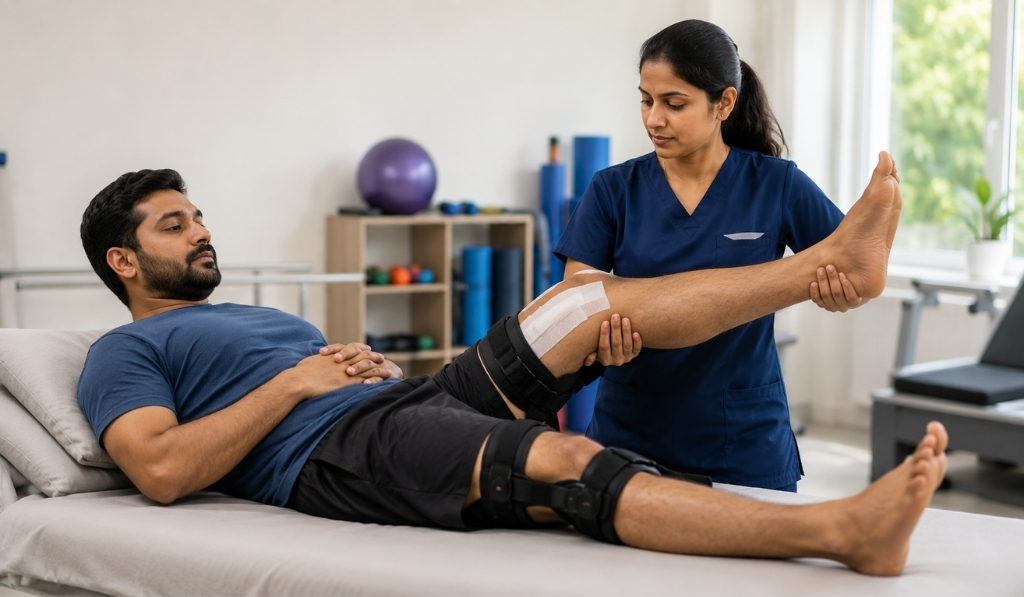
After orthopaedic surgery, many patients believe that the most challenging phase has passed. But often, the real recovery begins only after the operation.
How soon you start moving, how well your muscles regain strength and how closely you follow rehabilitation can affect your return to normal activities. This is where physiotherapy becomes an important part of recovery.
In this blog, we explain what to expect from physiotherapy after orthopaedic surgery, when it may begin, how it supports recovery and why a proper rehabilitation plan matters.
Synopsis
- Introduction
- Why Is Physiotherapy Important After Orthopaedic Surgery?
- What Happens During Physiotherapy in the Hospital?
- How Does Physiotherapy Support Recovery?
- Physiotherapy After Different Orthopaedic Surgeries
- What Happens After Discharge?
- Returning to Normal Activities
- How Long Is Physiotherapy Needed?
- When Should You Contact Your Doctor?
- Physiotherapy and Rehabilitation at P.D. Hinduja Sindhi Hospital
- Frequently Asked Questions
- Conclusion
Why Is Physiotherapy Important After Orthopaedic Surgery?
After surgery, the affected joint, bone or muscle may feel painful, stiff or weak. Movement may also become difficult for some time.
Physiotherapy helps patients regain function gradually through guided exercises and safe movement.
It may help with:
- Reducing stiffness
- Improving joint movement
- Rebuilding muscle strength
- Improving balance
- Supporting safe walking
- Returning to daily activities
- Regaining independence
The rehabilitation plan depends on the type of surgery and the patient’s condition.
What Happens During Physiotherapy in the Hospital?
Physiotherapy may begin soon after surgery when the doctor considers movement safe.
The physiotherapist first checks the patient’s condition. The assessment may include:
- Pain level
- Joint movement
- Muscle strength
- Balance
- Ability to sit and stand
- Walking ability
- Type of surgery performed
Based on this assessment, a suitable rehabilitation plan is prepared.
Early physiotherapy may include:
- Sitting up in bed
- Moving from bed to chair
- Standing with support
- Taking a few steps
- Gentle joint movements
- Simple muscle exercises
The aim is to help the patient start moving safely without putting unnecessary stress on the operated area.
How Does Physiotherapy Support Recovery?
Physiotherapy focuses on gradually restoring movement, strength and function.
Managing Pain and Stiffness
Pain and stiffness are common after surgery.The physiotherapist may use:
- Gentle exercises
- Controlled movements
- Correct positioning
- Ice therapy when suitable
- Relaxation techniques
These methods may help make movement more comfortable.
Improving Movement and Strength
Reduced activity before and after surgery can weaken muscles and limit joint movement.Exercises may include:
- Range-of-motion exercises
- Stretching
- Assisted movements
- Muscle strengthening
- Balance exercises
As the patient improves, we gradually increase the difficulty of the exercises.
Helping You Walk Safely
Some surgeries involving the hip, knee, ankle, leg or spine may temporarily affect walking.
Patients may practise:
- Standing safely
- Maintaining balance
- Taking the first steps
- Walking with the correct technique
- Climbing stairs when appropriate
Walking aids may also be recommended, such as:
- Walkers
- Crutches
- Walking sticks
The physiotherapist teaches the patient how to use them correctly.
Physiotherapy After Different Orthopaedic Surgeries
The rehabilitation programme changes according to the type of operation, the area affected, the patient’s overall condition, and the stage of recovery.
| After Knee or Hip Surgery | After Spine Surgery | After Fracture Surgery |
| Physiotherapy may focus on: | Patients may be taught: | Rehabilitation may include: |
| Improving joint movement | Safe ways to get in and out of bed | Joint mobility exercises |
| Building muscle strength | Correct sitting and standing | Muscle strengthening |
| Improving balance | Proper walking techniques | Balance training |
| Walking safely | Posture | Walking practice |
| Managing stairs | Gentle strengthening exercises | Gradual weight-bearing when allowed |
| Returning to routine activities | Ways to avoid unnecessary strain | Return to movement as advised |
The surgeon decides when and how much weight can safely be placed on the affected area.
What Happens After Discharge?
Physiotherapy often continues after the patient leaves the hospital. Patients may attend follow-up sessions and receive exercises to perform at home. A home exercise plan may include:
- Joint movement exercises
- Strengthening exercises
- Stretching
- Walking practice
- Balance exercises
Patients should follow the recommended number of exercises and avoid increasing the intensity too quickly.
During follow-up visits, the physiotherapist may adjust the programme according to:
- Pain
- Movement
- Strength
- Balance
- Walking ability
- Overall progress
Returning to Normal Activities
One of the main goals of rehabilitation is to help patients return safely to daily life.
Depending on recovery, physiotherapy may help patients with:
- Walking independently
- Climbing stairs
- Getting in and out of a chair
- Dressing and bathing
- Returning to work
- Driving when medically allowed
- Returning to suitable exercise
The timeline varies according to the surgery and individual recovery.
How Long Is Physiotherapy Needed?
There is no fixed rehabilitation period for every patient.
The duration may depend on:
- Type of surgery
- Age
- General health
- Muscle strength
- Severity of the original condition
- Healing progress
- Response to rehabilitation
Some patients may need physiotherapy for a few weeks, while others may continue for several months.
When Should You Contact Your Doctor?
Some pain and discomfort are expected during recovery.
However, seek medical advice if you develop:
- Sudden increase in pain
- Severe swelling
- Redness around the surgical area
- Fever
- New weakness
- Numbness
- Difficulty moving the operated limb
- Problems with the surgical wound
These symptoms may need further evaluation.
Physiotherapy and Rehabilitation at P.D. Hinduja Sindhi Hospital
At P.D. Hinduja Sindhi Hospital, Bangalore, physiotherapy may form an important part of recovery after orthopaedic surgery.
Depending on the patient’s needs, rehabilitation may include:
- Early post-surgery movement
- Joint mobility exercises
- Muscle strengthening
- Balance training
- Walking practice
- Assistive device training
- Home exercise guidance
- Follow-up rehabilitation
The programme is planned according to the surgery, stage of recovery and individual needs.
Frequently Asked Questions
Q1. When Does Physiotherapy Start After Orthopaedic Surgery?
Physiotherapy may begin soon after surgery when the surgeon considers it safe.
The timing depends on the type of operation and the patient’s condition.
Q2. Is Physiotherapy Painful After Surgery?
Some discomfort may occur during movement, especially in the early stages.
Exercises are usually introduced gradually and adjusted according to the patient’s comfort.
Q3. Is Physiotherapy Needed After Joint Replacement?
Physiotherapy is commonly recommended after knee and hip replacement surgery.
It can help improve movement, strength, balance and walking ability.
Q4. Can I Do Physiotherapy Exercises at Home?
Yes.
Patients are often given exercises to continue at home. They should be performed as advised by the physiotherapist.
Q5. How Long Does It Take to Walk Normally After Surgery?
The recovery time varies from patient to patient.
Some people begin walking with support soon after surgery, while others need a longer period of rehabilitation.
Q6. What Happens If Physiotherapy Is Not Followed Properly?
Not following the recommended rehabilitation plan may slow recovery and may contribute to stiffness, weakness or reduced movement.
Conclusion
Orthopaedic surgery treats the underlying problem, while physiotherapy helps patients regain movement, strength and function during recovery.
Rehabilitation usually starts with simple movements and progresses gradually as healing improves.
At P.D. Hinduja Sindhi Hospital, Bangalore, physiotherapy and rehabilitation support may be provided during the hospital stay and after discharge, based on the patient’s condition and recovery needs.