
We understand that good vision is essential for your everyday life. We also know that many people find it difficult to understand their eye power and eye prescription. That is why we have created this guide. It explains what eye power means, why it changes, the different types of eye power, and the available vision correction options.
What Is Eye Power?
Your eyes need to focus light accurately on the retina to produce clear vision. When light does not focus properly, objects may appear blurred. This is where the correct eye power helps improve your vision.
Eye power refers to the lens power required to help your eyes focus light correctly. It is measured in dioptres (D) and is used to determine the prescription for your spectacles or contact lenses.
Eye power does not indicate how healthy your eyes are. It simply shows the vision correction needed for clear sight. A comprehensive eye examination helps determine the correct prescription while also checking your overall eye health.
Understanding Your Eye Prescription
If you’ve ever looked at your spectacle prescription and wondered what the numbers and abbreviations mean, you’re not alone. Understanding a few basic terms can help you better understand your eye power.
What Does an Eye Prescription Include?
- SPH (Sphere): Corrects myopia (nearsightedness) or hyperopia (farsightedness).
- CYL (Cylinder): Corrects astigmatism.
- AXIS: Shows the direction of astigmatism correction.
- ADD (Addition): Provides extra lens power for near vision, usually for presbyopia.
Types of Eye Power
Different eye conditions require different types of vision correction. Your prescription depends on how light focuses inside your eyes.
Myopia (Nearsightedness)
Myopia makes distant objects appear blurred, while nearby objects remain clear. It occurs when light focuses in front of the retina instead of directly on it.
A minus (-) SPH value in your prescription corrects myopia by helping light focus properly on the retina.
Hyperopia (Farsightedness)
Hyperopia mainly affects near vision. People with this condition may find it difficult to read or perform close-up tasks without eye strain.
It occurs when light focuses behind the retina. A plus (+) SPH value helps move the focus onto the retina, making vision clearer.
Astigmatism
Astigmatism develops when the cornea or natural lens has an irregular shape. This causes light to focus unevenly, resulting in blurred or distorted vision at both near and far distances.
If your prescription includes CYL and AXIS, it means you have astigmatism. The CYL value indicates the amount of correction needed, while the AXIS shows the direction of that correction.
Presbyopia
Presbyopia is a common age-related vision problem that usually develops after the age of 40. As the eye’s natural lens becomes less flexible, focusing on nearby objects becomes more difficult.
People with presbyopia may need reading glasses, bifocal lenses, or progressive lenses. Their prescription usually includes an ADD value for additional near vision correction.
Signs Your Eye Power May Be Changing
Changes in eye power usually happen gradually, so you may not notice them at first. However, some signs may indicate that it’s time to visit an eye specialist.
You may notice:
- Blurred vision while reading or driving
- Frequent squinting
- Eye strain after prolonged screen use
- Difficulty seeing road signs clearly
- Headaches after visual tasks
- Holding books or mobile phones closer than usual
- Difficulty seeing at night
- Children sitting too close to the television or struggling to see the classroom board
If these symptoms become frequent, schedule a comprehensive eye examination.
What Causes Eye Power to Change?
Eye power can change for several reasons throughout life. Family history, age, eye growth, certain medical conditions, and daily visual habits can all affect how your eyes focus.
Genetics is one of the main causes, as refractive errors can be passed down from one generation to the next. During childhood and adolescence, the eyeball continues to grow in length. As the eye grows, eye power may also change.
With age, the eye’s natural lens gradually loses its flexibility. As a result, focusing on nearby objects becomes more difficult. Certain medical conditions, such as diabetes, may also cause temporary or permanent changes in vision, especially when blood sugar levels fluctuate.
In children and young adults, spending long hours reading, using computers, laptops, or mobile phones can contribute to the progression of myopia.
How Is Eye Power Measured?
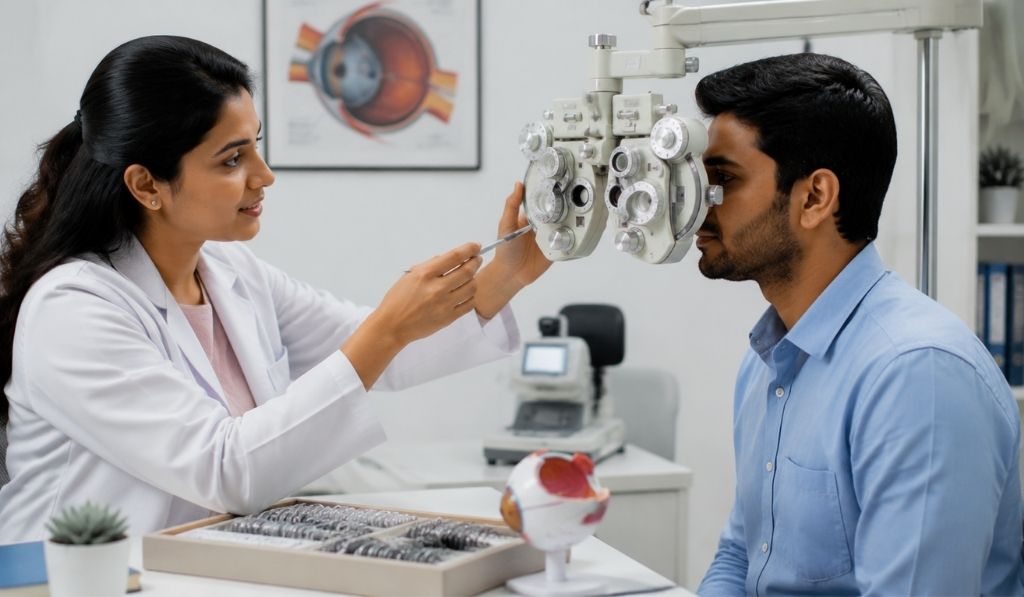
A comprehensive eye examination is the most accurate way to measure eye power. It helps your ophthalmologist determine the correct prescription and assess your overall eye health.
The examination usually begins with a visual acuity test, where you read letters from an eye chart to check how clearly you can see at different distances.
An Autorefractor provides an initial estimate of your eye power. Next, your Ophthalmologist performs Retinoscopy and Subjective Refraction to determine which lens gives you the clearest vision.
Your ophthalmologist may also examine your cornea, lens, retina, and optic nerve to detect any eye conditions that may affect your vision.
Vision Correction Options
The right vision correction option depends on your age, lifestyle, eye health, and eye power. After a detailed eye examination, your ophthalmologist will recommend the option that best suits your needs.
Prescription Glasses
Prescription glasses are one of the most common and effective ways to correct refractive errors. They provide clear vision and are available in different lens types to suit your daily activities and lifestyle.
Contact Lenses
Contact lenses are a good option for people who prefer not to wear glasses. They provide clear vision but require proper cleaning and good hygiene to reduce the risk of eye infections.
Laser Vision Correction
If you are eligible, procedures such as LASIK, SMILE, and PRK can reduce the need for glasses or contact lenses. A comprehensive eye examination is needed to determine whether laser vision correction is right for you.
Reading Glasses and Progressive Lenses
People with presbyopia may benefit from reading glasses, bifocal lenses, or progressive lenses. Your ophthalmologist will recommend the most suitable option based on your vision and daily needs.
Common Myths About Eye Power
There are many myths about eye power that can lead to confusion. Understanding the facts can help you make informed decisions about your eye health.
Myth: Wearing glasses makes your eyes weaker.
Fact: Glasses improve your vision by correcting refractive errors. They do not weaken your eyes or increase your eye power.
Myth: Eye exercises can permanently remove the need for glasses.
Fact: Eye exercises may help relieve eye strain, but they cannot permanently correct refractive errors.
Myth: Eye power changes only in children.
Fact: Eye power can change at any age due to natural ageing, certain medical conditions, or changes in the eyes.
Myth: Using a mobile phone always increases eye power.
Fact: Prolonged screen use can cause digital eye strain and dry eyes. However, it does not directly increase eye power in everyone.
When Should You Visit an Eye Specialist?
Regular eye examinations help monitor your eye health and detect eye conditions early. Schedule an eye examination if you notice:
- Sudden blurred vision
- Frequent headaches related to vision
- Persistent eye strain
- Double vision
- Flashes of light or new floaters
- Difficulty driving, especially at night
- Rapid changes in spectacle power
- Difficulty reading despite wearing glasses
Early diagnosis helps correct refractive errors and identify other eye conditions before they affect your vision.
Conclusion
Clear vision is important for reading, driving, working, and other everyday activities. Even if your vision seems normal, regular eye examinations are still important. They can help to detect early changes in your eyes and identify conditions that may require treatment. If you notice any changes in your vision, consult the Ophthalmologists at P.D. Hinduja Sindhi Hospital for a comprehensive eye examination and personalised treatment.
Frequently Asked Questions
Q1. Can eye power improve naturally?
Most refractive errors do not improve naturally. Clear vision usually requires spectacles, contact lenses, or suitable vision correction procedures.
Q2. What does minus eye power mean?
Minus eye power indicates myopia (nearsightedness). It means distant objects appear blurred because light focuses in front of the retina.
Q3. What is cylindrical eye power?
Cylindrical eye power corrects astigmatism, which occurs when the cornea or natural lens has an irregular shape, causing blurred or distorted vision.
Q4. Is laser vision correction suitable for everyone?
No. Eligibility depends on factors such as age, prescription stability, corneal thickness, and overall eye health. A detailed eye examination is needed to determine whether the procedure is suitable for you.
Q5. How often should I have my eyes examined?
Adults should have a comprehensive eye examination every one to two years, or more frequently if advised by their ophthalmologist. People with diabetes, existing eye conditions, or changes in vision may require more regular eye check-ups.