
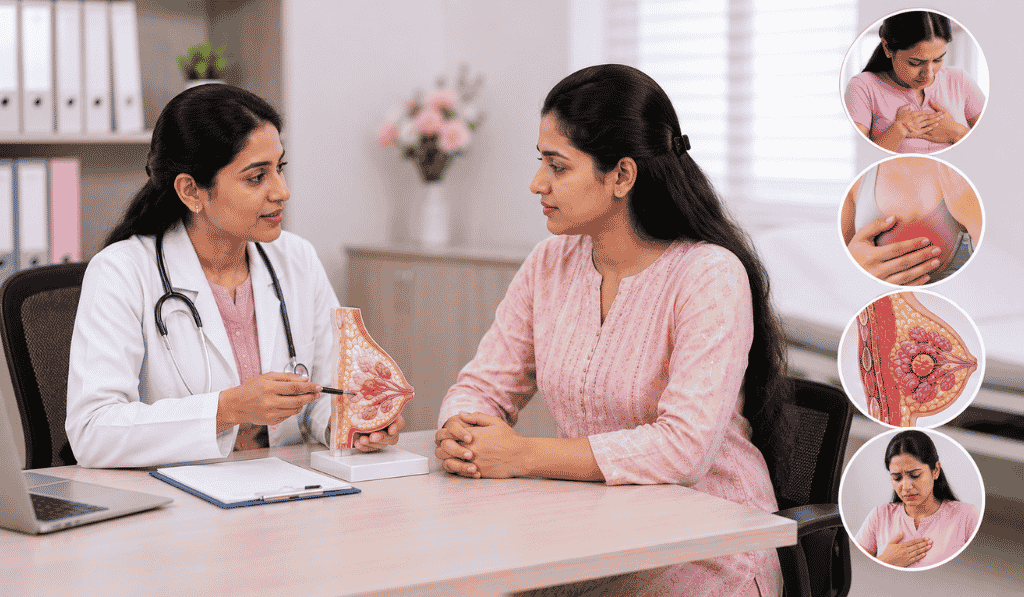
One in 28 women in India will develop breast cancer in her lifetime. Yet most women visit a specialist only after symptoms have been present for months — sometimes years. That delay costs lives.
At P.D. Hinduja Sindhi Hospital, Bangalore, Dr. Shreya has one clear message for every woman: your body gives you signals. Your job is to listen to them.
Let’s discuss one by one:
1. Signs You Should Never Ignore
Some breast changes are easy to dismiss as hormonal or temporary. Breast lump symptoms genuinely need a professional opinion:
- A new lump or thickening in the breast or underarm that persists beyond your menstrual cycle
- Sudden change in breast size or shape in one breast
- Persistent pain in one spot that does not go away
- Redness, warmth, swelling or discharge from nipple
- Dimpling or puckering of the skin, similar to the surface of an orange
If you notice any of the above, book an appointment at our breast cancer clinic in Bangalore without delay.
2. Breast Pain vs. Serious Symptoms — Know the Difference
Breast pain is one of the most common reasons women visit a breast pain specialist. The good news: most breast pain is cyclical — it comes and goes with your menstrual cycle and is usually harmless.
However, you should see a doctor when:
- Pain is non-cyclical (not linked to your period)
- Pain is localized to one specific area
- Pain is worsening over weeks despite rest or medication
- Pain is accompanied by a lump, skin change, or nipple discharge
A thorough clinical examination will quickly differentiate between benign breast pain and something that needs further investigation.
3. Skin Changes and Nipple Discharge
Skin and nipple changes are often the earliest visible warning signs, yet many women delay consulting a doctor because they do not appear “serious enough.”
Consult with a breast cancer specialist immediately if you notice:
- Nipple inversion — a nipple that has recently turned inward
- Nipple discharge — especially if it is blood-stained, occurs from one breast only, or happens without squeezing
- Skin thickening, scaling, or ulceration around the nipple (could indicate Paget’s disease)
- Unexplained skin redness that does not resolve within a week
These changes are rarely dangerous on their own, but they always deserve an expert opinion.
4. Family History and Breast Cancer Risk
If a close family member — mother, sister, aunt, or grandmother — has had breast or ovarian cancer, your personal risk increases. Dr. Shreya recommends that high-risk individuals begin annual breast evaluations from age 30.
A one-on-one consultation at our P.D. Hinduja Sindhi Hospital, Bangalore, includes a thorough review of your family history, helping you understand your personal risk level and plan a screening schedule that makes sense for you.
5. Why Clinical Examination Matters
Self-examination is valuable, but it has limits. During a clinical breast examination, experts examine both breasts and lymph nodes systematically, often identifying changes that are easy to miss at home. It is a simple, painless, and essential step before any diagnostic tests.
6. Diagnostic Tests Recommended by Dr. Shreya
Based on your symptoms and age, Dr. Shreya may recommend:
- Ultrasound – ideal for younger women with dense breast tissue
- Mammography – the gold standard for women above 40, used for both screening and diagnosis
- MRI of the breast – recommended for high-risk patients or inconclusive cases
- Fine Needle Aspiration Cytology (FNAC) or Core Biopsy – when a lump needs tissue-level analysis
7. Treatment Pathways Available
Not every breast condition requires surgery. Depending on the diagnosis, treatment options include:
- Medication and monitoring for benign cysts or fibrocystic changes
- Minimally invasive procedures for targeted biopsy or drainage
- Breast-conserving surgery (lumpectomy) for early-stage cancer
- Modified radical mastectomy when clinically necessary
- Oncoplastic reconstruction for cosmetic outcomes after surgery
Dr. Shreya works closely with oncologists and radiologists to create a personalised treatment plan for every patient.
8. The Power of Early Intervention
Breast cancer detected at Stage I has a survival rate exceeding 95%. By Stage III, that number drops significantly. Early intervention not only improves survival — it also means less aggressive treatment, shorter recovery, and better quality of life.
Do not wait for symptoms to become severe. A 20-minute consultation today could be the most important health decision you make this year.
Consult Dr. Shreya for Expert Breast Evaluation
Whether you have noticed a lump, experienced unexplained pain, or simply want a routine breast health check, Dr. Shreya at PD Hinduja Sindhi Hospital is here to guide you with compassion and clinical expertise.
📞 Book your appointment today 080-49030303 — because your health is most valuable.